
Junk Journalling for Artists: Collage Practice Disguised as a Craft Trend
Junk journal searches are up 63% year on year and the format is everywhere right now. For artists it is more useful than it looks: composition and colour practice with the drawing removed, built out of receipts, op-shop books and packaging you were going to bin anyway.
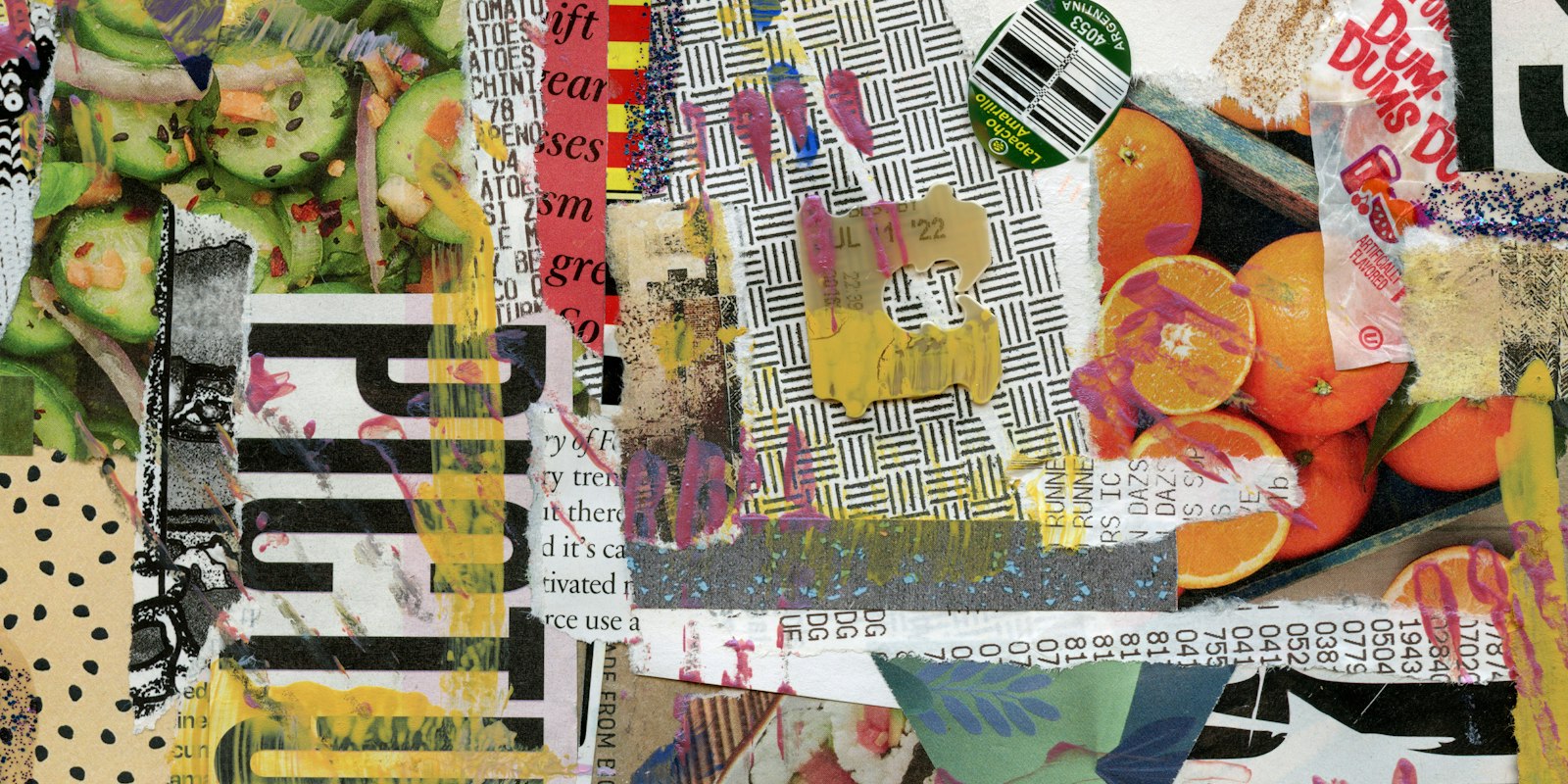
The biggest craft trend of 2026 is people gluing rubbish into books.
That is not a dig. Michaels’ 2026 Creativity Trend Report puts junk journal searches up 63% year on year, with vision boards up 61% right behind it. Searches for analogue hobbies as a group, knitting and crochet and embroidery and painting and journalling, jumped 136% in six months. There are well over 400,000 posts under the tag on TikTok. Michaels gave the underlying shift two names that are hard to forget: “Main Character Maintenance” and “Touching Grass Crafts”.
Most of the coverage treats this as a scrapbooking story. For anyone who already draws, it is something more specific and more useful: it is composition practice with the drawing taken out.
What a junk journal actually is
You take a book. You fill it with paper you did not buy: receipts, the inside pattern of a security envelope, junk mail, tea packaging, bread tags, ticket stubs, stamps off a parcel, pages torn out of a water-damaged paperback from the op shop. You cut it up, layer it, glue it down, write on it. Sometimes you draw on top. Often you do not.
The book fattens as it fills. That is part of the form. A finished junk journal is a physically thicker object than the one you started with, which is a satisfaction a sketchbook never quite gives you.
What it is not: a scrapbook with a theme, a bullet journal with a spread layout, or a planner. Those all have systems. This one has none, and the people arriving from #JournalTok are arriving precisely because it has none.
Why it is landing now
The honest read is that it is the same current we wrote about in the analog art comeback, arriving in a cheaper and lower-skill form. Gouache asks you to be able to paint. A junk journal asks you to own scissors.
That matters more than it sounds. The 136% surge is not illustrators taking up a second medium. It is a very large group of people who want to make something with their hands, have no drawing practice to fall back on, and have found the one analogue craft with an entry fee of zero and no skill floor at all. Michaels’ “Main Character Maintenance” framing gets at the rest of it: keeping a physical archive of your own life, in a year when everything else about it lives on a server.
The part that is actually useful to you
Here is the case for an artist bothering.
Strip a drawing down and it is doing four jobs at once: mark-making, rendering, composition and colour. Most of us practise the first two constantly, because they are the visible ones, and practise the other two almost never. Studies get rendered. Warm-ups get marked. Layout gets whatever attention is left over after the figure is drawn.
Collage removes the first two entirely. You cannot render a receipt. All you can do is decide where it goes, how big it is, what sits next to it, what it overlaps, which edge is torn and which is cut. That is composition, hierarchy, colour relationship and texture, isolated and practised on their own, with a feedback loop of about four seconds.
Three things it trains particularly well:
- Colour you did not choose. You work with the palette the rubbish gives you. A faded blue airmail envelope against a yellowed book page is a colour decision you would never have made in a picker, and it will teach you more about temperature and value than another tutorial. Our colour theory guide covers the theory; this is the part where you handle it.
- Edges. Torn, cut, burnt, singed, deckled, folded back. Illustrators are usually running two or three edge treatments on autopilot. A collage page runs eight.
- Type as shape. Found text is everywhere in this material. Learning to place a block of printed words as a compositional mass, rather than as something to read, is the skill that makes book covers and posters work.
None of that is why the trend is popular. It is just what happens to you while you do it.
What you need, honestly
Four things: a book, glue, scissors, a pen. Twelve to forty dollars, and you can do the low end.
- The book. It needs a binding that survives swelling to twice its thickness. A sewn or stitched binding handles this; a glued paperback spine splits and a spiral binding jams up. A cheap sewn notebook is better here than an expensive glued one. Some people make the book itself out of envelopes and paper bags, which is the purist route and also free.
- The glue. This is the one worth spending on. A glue stick works but warps thin paper as it dries and the cockling gets ugly across a whole spread. A tape runner like the Tombow Mono lays a dry adhesive that does not wet the paper at all, and it is the single upgrade that makes pages look intentional instead of homemade. PVA for anything thick.
- Scissors and a craft knife. Small sharp scissors for curves. A knife and a steel ruler for clean straights. Tearing against a ruler edge gives you the fibrous deckle everyone is after.
- A pen that sits on top of anything. Most fineliners skip across glossy packaging and printed ink. A gel pen, a Posca or a white gel highlighter will write over the top of receipts and magazine stock without beading.
Everything else is optional and most of it is marketing. Washi tape, stamps and sticker sheets are genuinely fun and genuinely unnecessary at the start.
Where the paper comes from: your recycling bin first, for a fortnight, before you buy anything. Then your letterbox, the op shop’s two-dollar book shelf, seed catalogues, old street directories and atlases, sheet music, Australia Post stamps off parcels, packaging with good printing on it. Tea boxes are disproportionately well designed. So are pasta packets.
The mistake artists make with it
Treating it as not-real-art and therefore not worth doing properly.
The tell is a journal that stays at the level of “things stuck down”. The pages that actually work are composed: something dominant, something secondary, a lot of quiet, and one deliberate accent. The same composition ideas that hold a painting together hold a spread together, and a junk journal where you are consciously applying them is worth ten where you are just filling space.
The other mistake is the opposite one, and it is the one that kills the habit: making each spread precious. If you have read our piece on keeping a sketchbook habit, the quality-bar problem there applies here too, with one advantage. The material cost you nothing. A spread you hate cost you a receipt and an old envelope. Glue something over it and keep going.
Posting the results
Spreads photograph better than most traditional work because they are flat, matte and shot at a size where a phone camera is genuinely sufficient. Indirect daylight near a window, camera square above the book, a weight just outside the frame to hold the pages open, no flash. Our guide to photographing and scanning traditional art covers the rest, and most of it applies unchanged.
Then post them as work, because they are. This is mixed media. It sits in the same category as any other traditional piece.
Where you post it changes what happens to it, though. A junk journal spread is exactly the kind of thing a ranked social feed handles badly: it is not a portfolio hero image, it does not read at thumbnail size, and it is part of an ongoing body of work rather than a standalone banger. It does much better somewhere that runs on tags and categories, where someone searching for collage or mixed media or traditional work can find the whole run of spreads at once, and where a collection can hold a journal as a single object rather than seventeen unrelated posts.
Final thoughts
You can get into this for the price of a glue stick, using paper you were about to put out for the recycling. The trend data says a lot of people already have. The reason to join them is not that it is trending; it is that composition is the thing you practise least and this is the cheapest possible way to practise it.
Start the book. Fill one spread a week. In six months you will have an object with a satisfying thickness and a noticeably better eye for where things go.
When you have spreads worth showing, artbase is free to join, covers traditional and mixed media alongside digital work, and is a place where a collage journal gets looked at instead of scrolling past.
Frequently asked questions
What is a junk journal?
A junk journal is a book made from and filled with found paper: receipts, packaging, ticket stubs, junk mail, pages from damaged second-hand books, envelopes, tea wrappers and stamps. You glue, layer and arrange that material across spreads, usually adding handwriting, stamps, washi tape or small drawings. There is no rule about what belongs on a page, which is most of the appeal.
What do I actually need to start a junk journal?
A book, glue, scissors and a pen. That is genuinely the whole list, and it costs somewhere between twelve and forty dollars depending on what you buy. Everything else, the paper itself included, can come out of your recycling bin, your letterbox and the two-dollar shelf at an op shop.
Is junk journalling useful if I already draw?
Yes, and for a reason most guides miss. Working with found paper strips out rendering and leaves you with the parts of picture-making illustrators practise least: layout, hierarchy, colour relationships, texture and edges. You are composing with ready-made shapes and type instead of making marks, which is a different muscle and a fast one to train.
Does a junk journal count as art I can post?
It counts. Spreads photograph well, they are mixed-media work by any sensible definition, and they suit communities with tags and categories better than they suit a ranked social feed. Shoot them flat in indirect daylight, keep the book open with a weight just outside the frame, and post them as the finished pieces they are.