
How to Keep a Sketchbook Habit You Actually Enjoy
Most sketchbook habits die of perfectionism, not laziness. How to build a daily(ish) sketch practice that survives busy weeks — ugly pages, tiny sessions, anchors and all.
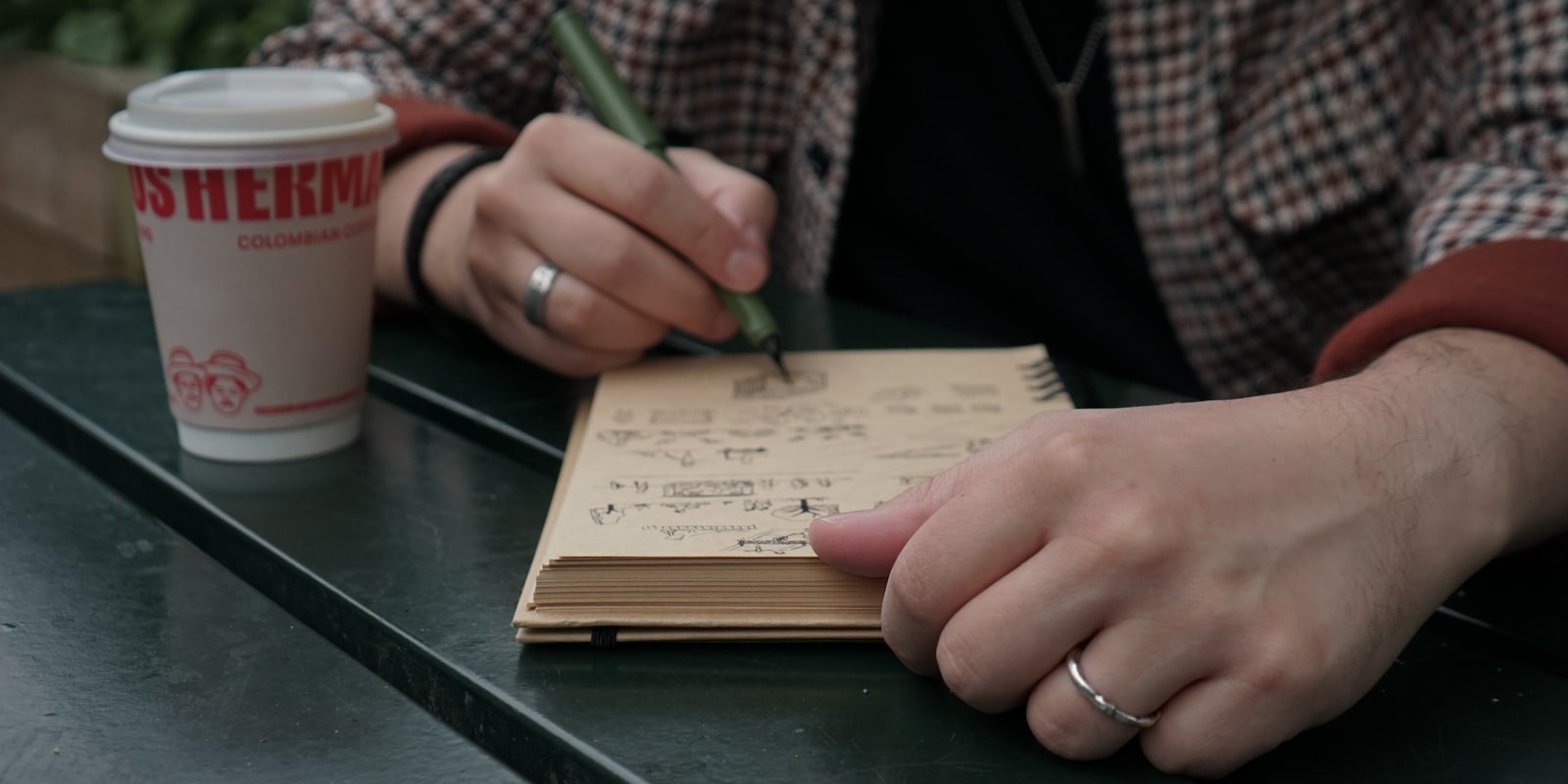
Every artist owns at least one: the beautiful sketchbook, three pages used, abandoned because page four had to be worth it. Sketchbook guilt is so universal it’s practically a rite of passage — and it comes from a single misunderstanding about what a sketchbook is for.
A sketchbook is not a gallery. It’s a gym. Nobody frames their push-ups. The moment a sketchbook’s job changes from performing to practising, the habit becomes not just possible but genuinely pleasant — and a daily(ish) sketch practice is the quiet engine under nearly every artist whose growth looks suspicious from the outside. Here’s how to build one that survives contact with real life.
Kill the quality bar first
The number-one sketchbook killer isn’t laziness — it’s stakes. A pristine book demands good pages; blank-page pressure defers the session; deferred sessions become a dead habit. So the first move is structural, not motivational:
- Declare it a no-quality zone, out loud, from page one. Some artists deliberately ruin the first page — a scribble, a coffee ring, “this book is for bad drawings” in marker — as a contract with themselves. Ceremonial, and weirdly effective.
- Cheap book, cheap pen. A $4 exercise book invites experiments the $40 hardcover archival tome forbids. You can graduate to nice paper once the habit is load-bearing.
- Nobody sees it by default. The sketchbook is exempt from posting. (Sharing the occasional page is fine — but as an export, chosen later, never as the page’s job while you’re drawing it. Fear needs an audience; deny it one, exactly as with fear-type art block.)
Perfectionism will still whisper that ugly pages are wasted pages. It has this exactly backwards: the ugly pages are the reps. A sketchbook with no failures in it is a gym where nobody sweats.
Make it small enough to survive Tuesday
Habits die of ambition. “An hour a day” works for eleven days, meets one busy Tuesday, breaks the streak, and takes the habit down with it. Build for your worst day instead:
- Five to ten minutes is the habit. More is welcome whenever it happens — but the commitment is one page, one object, one gesture sheet. Small enough that skipping feels sillier than doing it.
- Anchor it to something that already happens daily. With morning coffee; on the commute; last thing before bed. “When I have time” is not an anchor — it’s how three weeks disappear. Habits attach to moments, not intentions.
- Skip, don’t stack. Missed yesterday? It’s gone. Today is one page, not two. A make-up debt is how gyms and sketchbooks both get quietly avoided.
- Keep the kit staged. Book and pen on the table, tablet file pinned. Every step between impulse and first mark is a place the habit can leak.
If this sounds like the survival kit from the 30-day drawing challenge, it is — a sketchbook habit is that challenge with the calendar removed and the kindness turned up.
What actually goes on the pages
“Draw daily” fails without an answer to draw what? Rotate freely; the mix is the point:
- Life, constantly. The mug, the cat, your feet, the queue you’re standing in. Drawing from observation is the highest-nutrition filler there is, and the world restocks it daily.
- Warm-up mechanics. Line pages, ovals, boxes in space — the ten-minute warm-up menu is a complete sketchbook session on busy days.
- Prompts when the tank is empty. Keep a list handy — 100+ of them here — so “nothing to draw” never gets a vote.
- Thumbnails and idea capture. Composition roughs, character noodles, the idea from the shower before it evaporates. The sketchbook doubles as the idea bank from the inspiration system.
- Experiments you’d never risk on a real piece. New brush, wrong hand, no sketch layer, a style you’re curious about. The no-quality zone is precisely where these belong.
- Comfort drawing. The character again. The leaf again. Pleasure keeps habits alive; austerity kills them.
Digital counts fully, incidentally — a rough-canvas folder with the same no-quality rule is the same gym. The only caution: keep it separate from finished work, or the stakes creep back in.
The compounding part: date pages, revisit monthly
Number or date your pages and flip back through the book monthly. Two payoffs:
- Visible progress. Improvement is imperceptible day to day and undeniable across sixty dated pages. On motivation-dead days, the flip-through is the motivation — proof the reps are landing, in your own handwriting.
- A private idea mine. Last month’s throwaway thumbnail is this month’s finished piece. Artists who mine old sketchbooks are never short of what to make next.
This is also where the sketchbook quietly feeds everything else: the observational reps sharpen your deliberate practice, the thumbnails feed finished work, and the sheer accumulated mileage is what “suddenly improved” artists turn out to have in common.
Final thoughts
A sketchbook habit needs three decisions, none of them about talent: the quality bar goes to zero, the session shrinks until your worst Tuesday can hold it, and it attaches to a moment that already happens every day. Cheap book, staged pen, ugly first page on purpose — then five minutes tomorrow, anchored to the coffee. The gym is open.
Frequently asked questions
How do I start a daily sketchbook habit?
Start embarrassingly small — five to ten minutes, attached to an existing daily anchor like morning coffee — and declare the sketchbook a no-quality zone from page one. Habits fail from ambition (an hour a day, every day, only good pages) far more often than from laziness. Miss a day? Skip it, never make it up.
Why can't I keep a sketchbook habit?
Almost always one of three reasons: the bar is too high (every page must be good), the session is too big (an hour feels like homework, so it gets deferred), or there is no anchor (drawing happens "when there's time", and there never is). Lower the quality bar, shrink the session, and attach it to a fixed daily moment.
Should a sketchbook be neat or messy?
Messy — or more precisely, whatever serves the thinking. A sketchbook is a gym, not a gallery: its job is reps, experiments and honest failures. Artists who keep pristine sketchbooks usually draw less, because every blank page carries stakes. Keep polish for finished pieces and let the sketchbook be the one place quality is officially irrelevant.
Do digital sketchbooks count?
Completely. The habit is the daily low-stakes drawing, not the paper. A dedicated "sketchbook" folder or file with rough canvases works the same way — the one caution is to keep it separate from your finished-work space, so the no-quality rule stays believable.