
Drawing Warm-Ups That Are Actually Worth Ten Minutes
A good warm-up loosens your arm, calibrates your eye and lowers the stakes — in ten minutes. The exercises artists actually use: lines and ovals, gestures, blind contours and more.
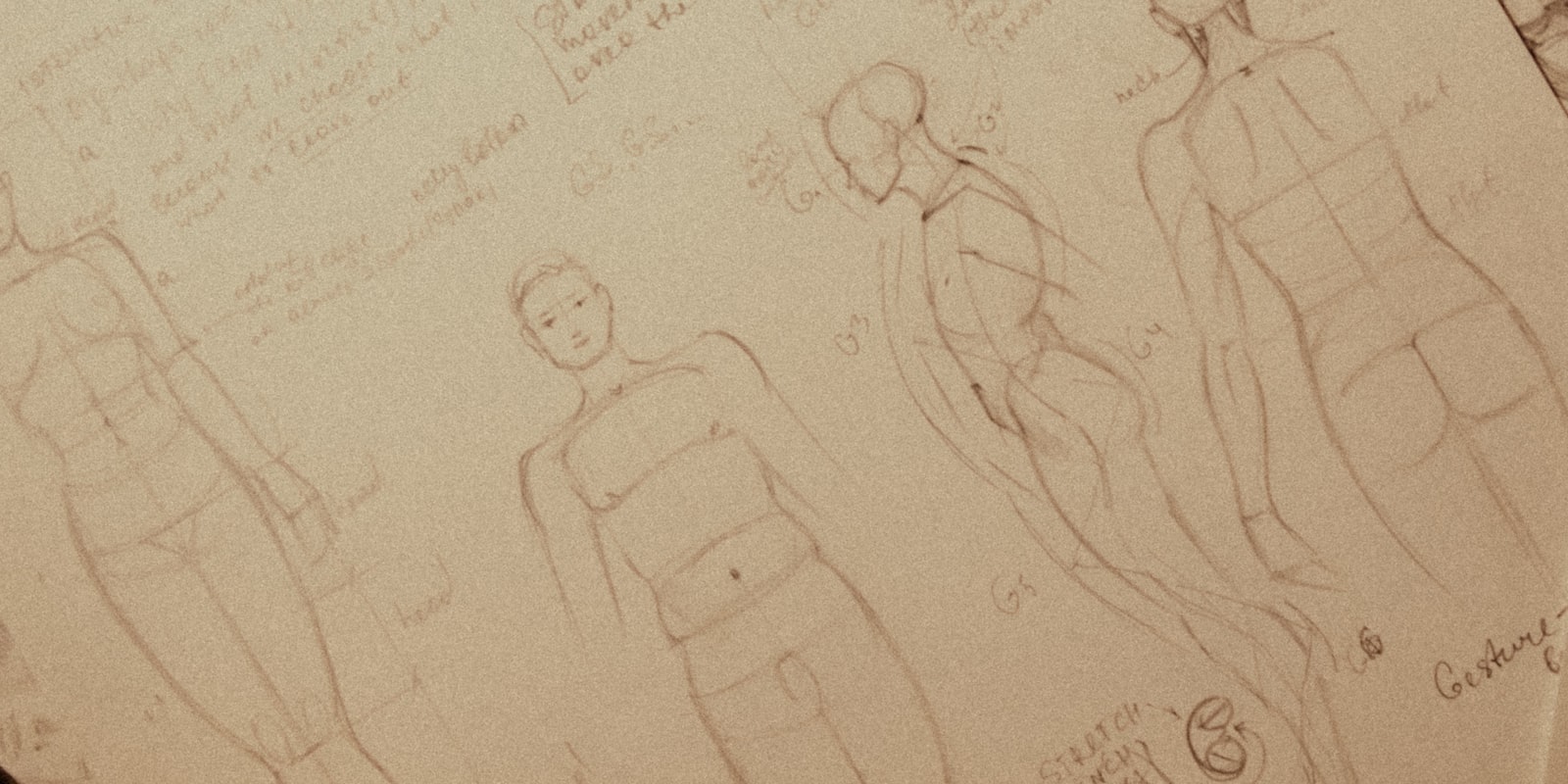
Watch a musician before a concert or a sprinter before a race and you’ll see the same thing: nobody starts at full intensity from cold. Somehow artists skip this — we open the file, aim the very first stiff, sleepy mark of the day directly at the piece we care about, and then wonder why the first hour’s work gets redrawn.
A warm-up fixes three things at once: it loosens the arm (physical), it calibrates the eye (observational), and — sneakily most important — it lowers the stakes, giving you a few minutes of marks that officially don’t count, which is often all the runway a reluctant session needs. Here’s a menu of exercises that earn their minutes, and how to assemble them into a routine that stays under ten.
The physical layer: lines, ovals, and the shoulder
Shaky, hairy, wobbling lines are rarely a talent problem — they’re a mechanics problem: drawing from the wrist (a two-inch range of motion) instead of the shoulder, and drawing too slowly (slow lines record every tremor; confident medium-speed lines average them out).
- Line pages. Fill part of a page with straight lines: horizontal, vertical, diagonal. Draw from the shoulder — the wrist stays locked, the whole arm moves. Ghost each line first: hover the stroke in the air once or twice, then commit in one motion. No feathering, no sketchy little strokes — one line, drawn once.
- Point-to-point. Scatter dot pairs, connect each with a single ghosted stroke. Adds a target, which is what most real lines have.
- Ovals and circles. Rows of them, drawn fast, trying to close each smoothly. Then spirals wound tight-to-wide. Ovals are the hardest everyday mark to make cleanly, which is exactly why they’re a warm-up staple.
- Speed note: if your warm-up lines look worse when drawn faster — good. Slightly-too-fast is the training zone. Accuracy catches up; hesitation never does.
Five minutes of this before line work produces visibly cleaner strokes the same day. It’s the closest thing to an instant upgrade in this article.
The observational layer: gestures and blind contours
- Gesture drawings. 30–60 seconds per pose, capturing the action — the sweep of the spine, the push of the weight — never the outline. Ten gestures in eight minutes wakes up the part of your brain that sees wholes instead of edges. Endless free photo-reference sites exist for exactly this; figures, animals, whatever you’re drawing today.
- Blind contours. Draw an object — your non-drawing hand is the classic — without looking at the paper, pen never lifting, eyes tracing the actual edges slowly. The results are gloriously wrong. The point is the looking: two blind contours force more genuine observation than twenty glanced-at sketches, and they’re unfailingly funny, which is its own kind of session-starter.
- Simple forms in space. Boxes and cylinders, rotated freely, at various angles. This is the vocabulary everything else is written in — thirty seconds of boxes is stealth perspective practice without the ruler.
The stakes layer: marks that don’t count
If your problem isn’t a stiff arm but a reluctant start — the cursor hovering, the dread — the warm-up’s real job is permission. Two tools:
- The scribble page. One page of genuinely meaningless marks: scribbles, texture patches, pen pressure tests. It declares the session open without asking anything of you. Momentum does the rest — the same two-minute-start principle that breaks fear-type art block.
- The comfort doodle. One tiny drawing of a thing you always enjoy — your comfort character’s face, a leaf, a skull. Not practice, just pleasant. It reminds your brain why it showed up.
Assembling your ten minutes
Rotate, don’t stack — the whole point is brief. A sane default:
- 2 min: lines and ovals, shoulder-drawn, ghosted
- 4 min: five gestures at ~45 seconds
- 2 min: boxes in space or one blind contour
- 2 min: comfort doodle, then straight into the real session
Adjust by session: line-art day → weight the lines; figure day → double the gestures; can’t-start day → scribble page first, rules later. And two boundaries worth keeping: a warm-up that swells past fifteen minutes has quietly become practice or procrastination (both fine — but notice which), and warm-ups aimed at a specific weakness with focused reps have graduated into deliberate practice — a different tool for a different job.
On genuinely short days, the warm-up can be the session. Ten minutes of gestures keeps a daily sketch habit alive through weeks when nothing bigger fits, and that continuity is worth more than any single drawing.
Final thoughts
Warm-ups are unglamorous, cost ten minutes, and pay off the same day: looser lines, a calibrated eye, and a session that starts because starting stopped being scary. Steal the default routine above, rotate the menu when it stales, and stop aiming your coldest marks of the day at the drawing you care about most.
Frequently asked questions
Should you warm up before drawing?
Yes, for the same reason athletes and musicians do: the first marks of a session are reliably stiff, and a short warm-up absorbs that stiffness so it does not land on the piece you care about. Five to ten minutes of lines, ovals and gestures noticeably improves line confidence for the rest of the session — and doubles as a low-stakes way to start on reluctant days.
What are good drawing warm-up exercises?
The classics: pages of straight lines and smooth ovals drawn from the shoulder, quick gesture drawings of thirty to sixty seconds each, blind contour drawings, and simple 3D forms — boxes and cylinders — rotated in space. Pick two or three and rotate; the whole routine should take five to ten minutes, not thirty.
How long should a drawing warm-up take?
Five to ten minutes is plenty. A warm-up that regularly runs longer has become practice or procrastination — both fine, but different things. On very short sessions, even two minutes of lines and ovals beats starting cold.
Why is my line art so shaky?
Usually a combination of drawing from the wrist instead of the shoulder, drawing too slowly (slow lines wobble; confident medium-speed lines stay straight), and starting cold. Warming up with shoulder-drawn line pages, ghosting each stroke before committing, and increasing stroke speed slightly fixes most shakiness within weeks.