The First Hundred: An Interview With mondstern
He was the fourth account ever created on artbase, and the first person to find the place on his own. Within ten minutes of signing up he had posted his first painting. Two days later he had posted a hundred. An interview with mondstern, who paints open-source app icons in acrylic and hangs them on gallery walls in Germany.
The fourth account ever created on artbase belongs to a painter in Germany who goes by mondstern.
The first three were me and two friends I know in real life, which is how these things usually start. mondstern is the first person who found the place on his own, and one evening in July he signed up and, within about ten minutes, uploaded a painting of the Godot Engine logo. Acrylic, small square canvas, brush marks visible, canvas weave showing through the blue.
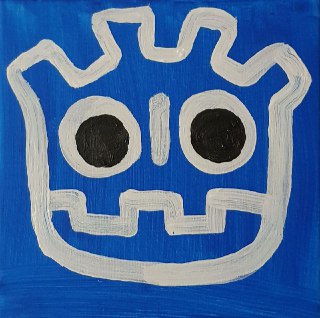
Two days later he had posted a hundred of them.
mondstern is German for moon star. He paints the logos of free and open-source software as small acrylic paintings, and then hangs them in galleries. There are over 1200 of them now. Seven exhibitions in Germany so far.
I sent him some questions and he answered them on his own blog, in English, which is not his first language.
What follows is mostly in his own words. A few sentences came out of the translation badly and I’ve cleaned those up, but the phrasing is his.
He was a musician first
I did not expect this, and it changes how everything else reads. Painting was not the plan. It was what was left over.
“I’ve only been painting with acrylic since October 2018. The whole thing had a rather sad background. I used to be a hobby musician. I studied violin for 10 years, trumpet for 13 years, saxophone for 10 years and piano for 2 years. I gave lessons during training periods, was in big bands, had recorded CDs, was in a gospel choir, and had composed 100 pieces of music myself.
My life changed in 2017. I got a burnout in March 2017 which lasted until June 2018, so 16 months. After that I had tried to make music, but it was no longer possible. So I was very frustrated. A friend drove me to Dresden to sing in October 2018 and there I got the inspiration, that I should paint acrylic paintings.”
Twenty-five years of instruments and a hundred compositions, and then he couldn’t do it any more. When I asked whether art had always been part of his life, he was pretty plain about where it actually came from:
“Art at school was one of my favorite subjects. In the burnout, it slowly started that I am interested in art. Always as the strength gives, if I can speak of strength at all, because I was so exhausted.”
What he actually paints
If you don’t spend time around open-source software the subject matter needs explaining, so I asked him to explain it.
“F-Droid is the free app store for Android. In February 2026 I had painted the last app icon for Android. And Flathub is the app store for Linux. I have been painting these app icons since May 2026.”
App icons, then. Godot, Joplin, mpv, Tor Project, Bitwarden, Debian, FileZilla, qTox. Little pictograms drawn to be legible at 48 pixels, scaled up and redone by hand in paint, at which point you can see every brush stroke and every place the bristles dragged.
The open-source part isn’t incidental to him. He’s involved in the ordinary ways too:
“I mainly paint logos of open source apps, that’s right. Occasionally I also paint other things, such as emoji, action banners. FAITH, HOPE, LOVE and WELCOME HOME I had painted in 2019 with the idea that I would find people who hold that up and others take pictures.
Open source software means that the source code is public and can be viewed, modified and used. Open source software can be used and distributed free of charge in compliance with the license terms. So I can participate, also with programming, search for and report errors, translate software, help others, test and promote apps.”
I wanted to know whether he has to like an app to paint its icon, and whether a bad app can have a nice logo. He’s more even-handed about it than I would be:
“I paint as it happens, whether I have the colors for it, whether I have the time to paint it now. And it depends on whether I can reconcile it with my conscience.”
“It depends on the purpose of application. If I don’t have anything there, I can’t use it. For me, every app is actually worth the same amount.”
The economics, which are not good
I asked what a painting costs him in materials, and what he’d charge someone who wanted one. He declined to give me a number twice, and the reason becomes obvious:
“I can’t name a price. It costs the canvas, the brush, the paints. Then comes the time, the way I implement it, and the drying of the paint. It’s not just the acrylic painting.”
“I rarely sell a picture. Expenses exceed revenues. From October 2018, that’s when I started painting, until October 2023, I had 3000 Euros in expenses for canvases, brushes, paints and boxes. And since the Corona period, now everything is getting even more expensive. I can’t talk about revenue. But yes, you can also buy acrylic paintings from me. In general, I cannot name a price, it depends on what we are talking about and what the situation is.”
Three thousand euros out over five years, against revenue he won’t describe. The paint mostly comes from discount supermarkets:
“There are acrylic paints with water, without water, acrylic oil paints, acrylic metallic paints and artists acrylic paints. Mostly I buy those without water. Most of the paint is from Action Nederland, that is, from supermarkets or from discounters. Sometimes I also get acrylic paints from people as a gift. I am happy about that, of course, very much.”
Working small and fast helps:
“For the size 20x20, 10 minutes, although that also varies. It took me 30 minutes to paint Gadgetbridge. Before that I had thought about how I would implement it, and then the acrylic painting still dries. So with this picture it was maybe 1 hour.”
There’s no quota either, though there is a reason to keep going:
“After the first 6 months I had painted 150, and if I want to release a new version of my icon theme for Linux, I think about how many more acrylic paintings I would have to paint. I don’t have a plan for a certain number.”
Why paint them at all
This was the question I most wanted an answer to. The logos are already digital images. Painting one by hand gives you a physical object which then has to be photographed to be shared, so you end up more or less back where you started. His answer is that the physical object is the entire point:
“I would like to show it to others by analogy, so not just a digital image. At exhibitions, visitors have it right in front of them. Otherwise I would have to hold my smartphone in front of people’s noses every time. This is a crazy idea.”
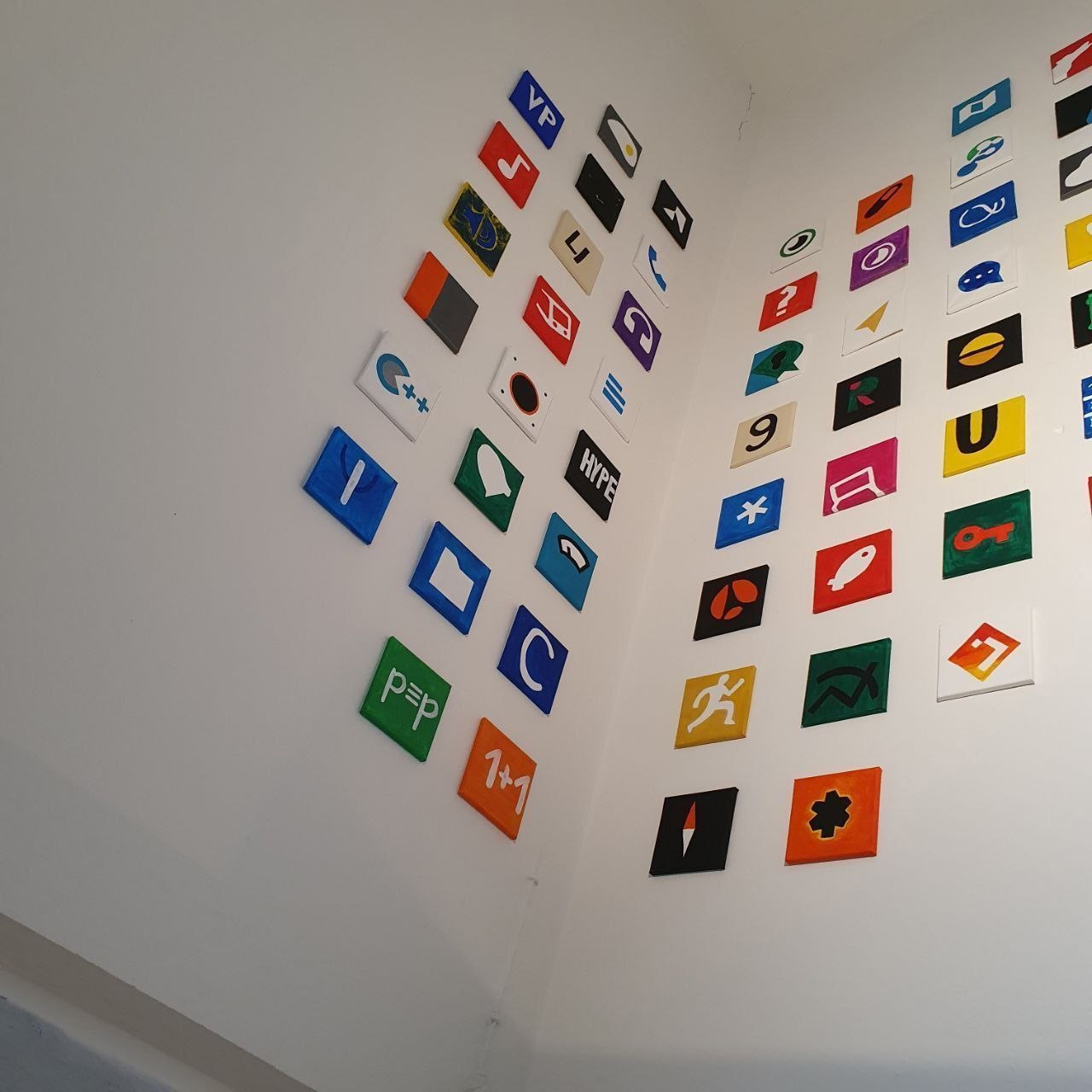
Seven exhibitions so far, in Berlin, Dresden, Meissen, Zwickau and Radebeul. The paintings then go back out under the same terms the software came in under:
“I have licensed all my acrylic paintings under CC BY-ND 4.0, which means, among other things, you can use my acrylic paintings, but you have to name me.”
The developers have seen them
I had to ask whether anyone who wrote one of these apps has ever stood in front of a painting of their own icon.
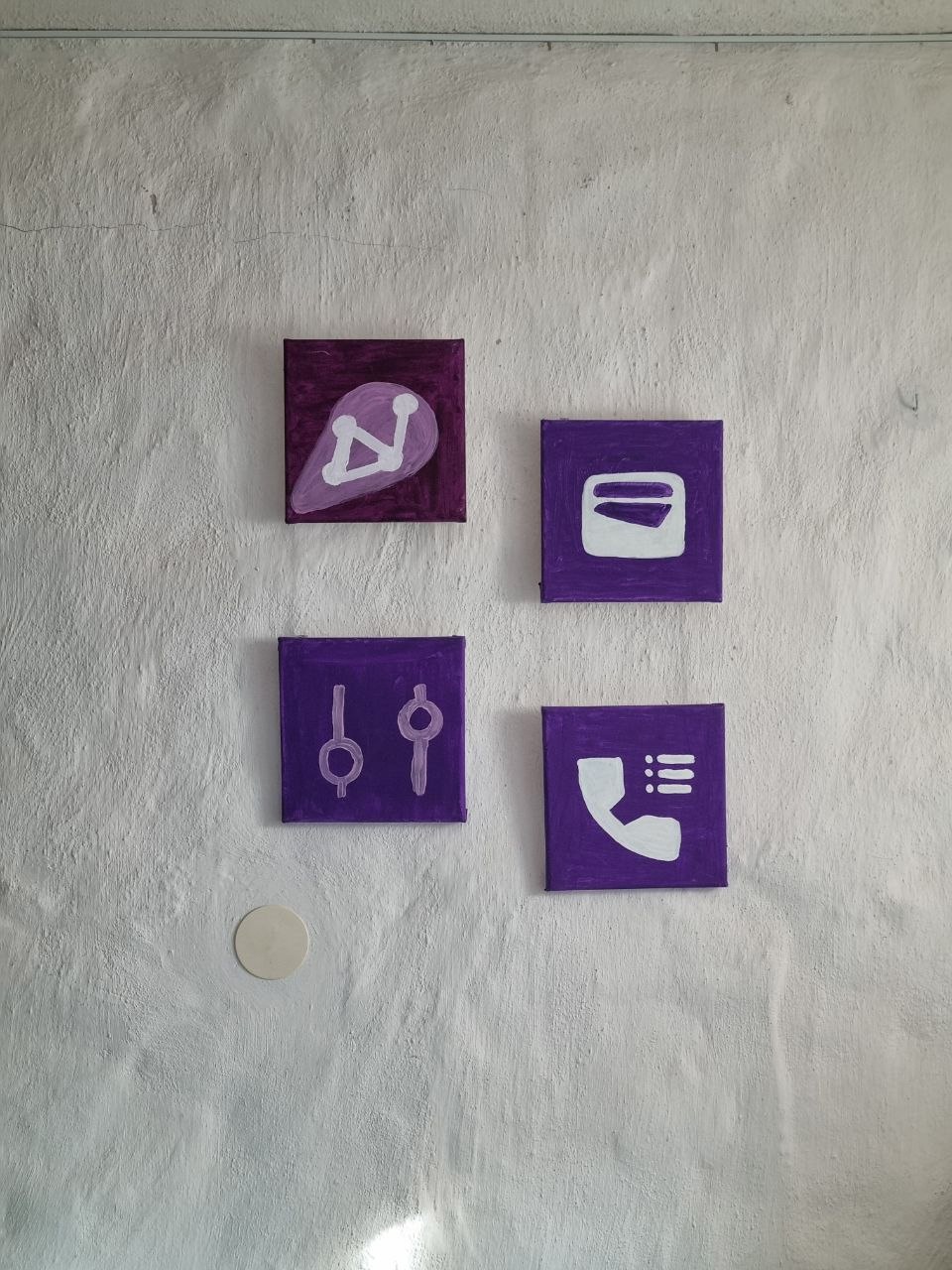
“The exhibition in Berlin has been open to the public since 2020. And the programmer of the app FitoTrack visited my first exhibition in 2023 and he said: ‘This is awesome.’ The MediLog programmer has ordered 2 acrylic pictures of his app at once.”
It works in the other direction as well. People walk into a gallery, look at some paintings, and go home and install software:
“From my last exhibition in Radebeul, Germany, September 2025 to January 2026, I remember that visitors had installed 5 opensource apps. I suspect this was also the case at other exhibitions, e.g. in Berlin.”
The Windows 7 years
One thread I kept pulling on. He bought SuSE Linux 6.0 on four CDs back in 1998, and then ran Windows for most of the next twenty-eight years, sitting on Windows 7 until May 2026.
“I bought SuSE Linux 6.0 at that time because I was amazed that it was so inexpensive in contrast to Windows. I had tried to use Linux from October 2003, but I couldn’t cope with it. That’s how I installed Windows.
I was in Halle at a Linux Interessengemeinschaft in 2019, in September 2023 in Zwickauer Hackspace for my fifth exhibition opening, and the hackspace in Jena had also recommended Linux Mint to me. I have now installed the Linux Mint Debian Edition (LMDE7).”
What eventually moved him was people, over years. A user group, a hackspace that hosted one of his exhibitions, another hackspace that made a suggestion.
Acrylicons, and the juice bottles
The last thing I asked about was the strangest item on his blog, which involves QR codes on juice bottles.
He is relentless about finding new surfaces to put his work on. Jam jars from a manufactory in Freital carried seventeen of his paintings with QR codes through most of 2023, until the company folded. In October 2025 he approached KEKILA, the juicery his family has been drinking from since it was founded in 1986, about doing something similar on bottle labels, with the code taking you to an icon pack you could install.
Then the technical ground shifted under him. The Android icon pack he’d written in 2021 stops working this month. He had Windows 7 and no Linux machine to build a replacement on. So:
“I had to rethink. I have seen that this is also possible with Linux. From February 2026 to May 2026 I had asked if someone could give me a used PC, and in May 2026 I had been given one: a PC, a monitor, one keyboard and one PC mouse. Since the end of May 2026 there is my Acrylicons, an acrylic icon theme for Linux desktops. The first version currently has 62 acrylicons. It no longer shows the original icons for those app icons, but my acrylic pictures.”
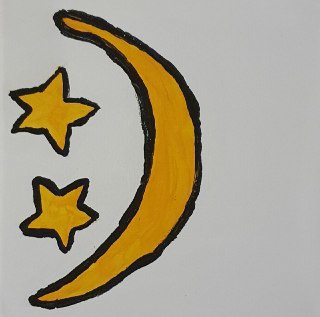
So he spent three months asking strangers for a computer, got one, and used it to ship an icon theme that puts photographs of his paintings on other people’s desktops in place of the real icons. The bottles are still outstanding:
“My KEKILA bottle with Acrylicons does not exist yet, but you can already install the icon theme. The way to get acrylic pictures on KEKILA juice bottle labels is not so easy and will take some time. It’s one of my goals.”
The hundredth painting
Which brings me back to where this started.
He signed up one evening in July and posted his first painting almost immediately. Two days later he was past a hundred, and he’s at 123 now. The fifth member of artbase didn’t sign up until nearly a week after him, so for that whole stretch the site was four accounts and he was filling it more or less on his own, with hardly anyone there to see it.
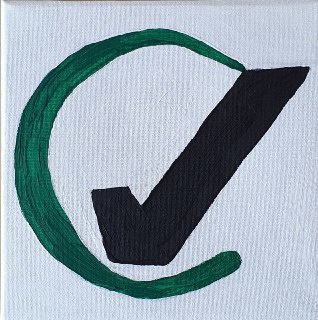
The hundredth was the icon for an app called OpenTodoList, a green circle and a black tick.
Thank you
There’s a version of this post that turns him into a lesson about consistency and showing up. I don’t think he’d recognise himself in it. He signed up to an art site with four users, started uploading, and didn’t stop, and as far as I can tell the near-total absence of an audience didn’t enter into it.
He finished his answers like this:
“Vielen Dank für Deine Fragen, die diesmal aus Australien kamen.”
Many thanks for your questions, which this time came from Australia.
Thank you for the answers, and for being first.
Find mondstern: artbase.au/@mondstern · his blog · Instagram
All paintings © mondstern, licensed CC BY-ND 4.0 and reproduced here unmodified. His full, unedited answers are published as “Interview with Matt from Australia” on his own blog, with a mirror here.
Frequently asked questions
Who is mondstern?
mondstern is a German artist who hand-paints the logos of open-source apps as small square acrylic paintings on canvas. He has been painting since October 2018, has made over 1200 pieces, and has exhibited seven times in Germany. On artbase he was the first member who was not already a friend of the founder, and the first to post 100 artworks.
What does mondstern paint?
He paints the app icons of free and open-source software — apps from F-Droid, the free app store for Android, and from Flathub, the app store for Linux — as small acrylic paintings on square canvases. He also paints emoji, action banners and occasional other subjects.
How long does one of mondstern's paintings take?
About ten minutes for a 20x20cm canvas, though it varies. A more complex icon such as Gadgetbridge took thirty minutes to paint, and closer to an hour once the planning and the drying time of the acrylic paint are counted.
Can you use mondstern's paintings?
Yes, within limits. He has licensed all of his acrylic paintings under Creative Commons BY-ND 4.0, which means you may use and share them provided you credit him by name and do not distribute modified versions.
What is Acrylicons?
Acrylicons is an icon theme for Linux desktops made from mondstern's acrylic paintings. Instead of the original app icons, the desktop shows photographs of his hand-painted versions. The first release, from May 2026, contains 62 icons.
What is a Founding Member on artbase?
Founding Member is the permanent role given to early artbase members, including everyone who joined during the invite-only early access period. It carries a badge on the member's profile and Pro at no cost for life. It closed to new members at the end of Sunday 6 September 2026 and cannot be earned again.